<?xml version="1.0" encoding="UTF-8"?><feed
  xmlns="http://www.w3.org/2005/Atom"
  xmlns:thr="http://purl.org/syndication/thread/1.0"
  xml:lang="en"
  xml:base="http://theags.org/wp-atom.php"
   >
	<title type="text">The Ags</title>
	<subtitle type="text">Just another WordPress weblog</subtitle>

	<updated>2014-04-29T15:43:02Z</updated>
	<generator uri="http://wordpress.org/" version="2.9.2">WordPress</generator>

	<link rel="alternate" type="text/html" href="http://theags.org" />
	<id>http://theags.org/feed/atom</id>
	<link rel="self" type="application/atom+xml" href="http://theags.org/feed/atom" />

			<entry>
		<author>
			<name>alexandra</name>
						<uri>http://</uri>
					</author>
		<title type="html"><![CDATA[The AGS project is to be re-started during 2014]]></title>
		<link rel="alternate" type="text/html" href="http://theags.org/ags-international/the-ags-project-is-to-be-re-started-during-2014" />
		<id>http://theags.org/?p=2742</id>
		<updated>2014-04-29T15:43:02Z</updated>
		<published>2014-04-29T15:42:38Z</published>
		<category scheme="http://theags.org" term="ags international" /><category scheme="http://theags.org" term="highlight" />		<summary type="html"><![CDATA[The project is no longer active in its current formation.
If any questions please contact: thomas.pettersson@chalmers.se
]]></summary>
		<content type="html" xml:base="http://theags.org/ags-international/the-ags-project-is-to-be-re-started-during-2014"><![CDATA[<p>The project is no longer active in its current formation.</p>
<p>If any questions please contact: <a href="mailto:thomas.pettersson@chalmers.se">thomas.pettersson@chalmers.se</a></p>
]]></content>
		<link rel="replies" type="text/html" href="http://theags.org/ags-international/the-ags-project-is-to-be-re-started-during-2014#comments" thr:count="0"/>
		<link rel="replies" type="application/atom+xml" href="http://theags.org/ags-international/the-ags-project-is-to-be-re-started-during-2014/feed/atom" thr:count="0"/>
		<thr:total>0</thr:total>
	</entry>
		<entry>
		<author>
			<name>alexandra</name>
						<uri>http://</uri>
					</author>
		<title type="html"><![CDATA[Annual Meeting 2011: &#8220;Sustainability and Change&#8221;]]></title>
		<link rel="alternate" type="text/html" href="http://theags.org/outreach/annual-meeting-2011-sustainability-and-change" />
		<id>http://theags.org/?p=2581</id>
		<updated>2011-01-04T14:05:14Z</updated>
		<published>2011-01-04T14:04:36Z</published>
		<category scheme="http://theags.org" term="annual meeting" /><category scheme="http://theags.org" term="chalmers" /><category scheme="http://theags.org" term="highlight" /><category scheme="http://theags.org" term="outreach" />		<summary type="html"><![CDATA[23-25 January 2011, Chalmers University of Technology, Gothenburg, Sweden.
Our planet is faced with a number of rapid changes over the coming decades. These changes include:

a changing climate
growing demand for food
constraints of resources
increasing global population and urbanisation
ageing societies

Although the extent of these changes is difficult to predict, the  consequences of not meeting the challenges are <a href="http://theags.org/outreach/annual-meeting-2011-sustainability-and-change">(more...)</a>]]></summary>
		<content type="html" xml:base="http://theags.org/outreach/annual-meeting-2011-sustainability-and-change"><![CDATA[<p><strong><em>23-25 January 2011, Chalmers University of Technology, Gothenburg, Sweden.</em></strong></p>
<p>Our planet is faced with a number of rapid changes over the coming decades. These changes include:</p>
<ul>
<li>a changing climate</li>
<li>growing demand for food</li>
<li>constraints of resources</li>
<li>increasing global population and urbanisation</li>
<li>ageing societies<span id="more-2581"></span></li>
</ul>
<p>Although the extent of these changes is difficult to predict, the  consequences of not meeting the challenges are all the better known.</p>
<p>In this meeting we will address these key issues through the AGS  research initiatives and look for sustainable solutions in the face of  change. The meeting includes prominent speakers from industry and  society, panels of experts and briefings by AGS researchers on the key  issues.</p>
<p>The AGS annual meeting will be held on 23-25 January 2011, and  continues in collaboration with the Energy Conference on 26 January  2011.</p>
<p>Welcome to Gothenburg!</p>
<p>Contact: <a href="mailto:ags2011@chalmers.se">ags2011@chalmers.se</a></p>
<p>More information:<a href="http://ags2011.org" target="_blank"> www.ags2011.org</a></p>
]]></content>
		<link rel="replies" type="text/html" href="http://theags.org/outreach/annual-meeting-2011-sustainability-and-change#comments" thr:count="0"/>
		<link rel="replies" type="application/atom+xml" href="http://theags.org/outreach/annual-meeting-2011-sustainability-and-change/feed/atom" thr:count="0"/>
		<thr:total>0</thr:total>
	</entry>
		<entry>
		<author>
			<name>alexandra</name>
						<uri>http://</uri>
					</author>
		<title type="html"><![CDATA[EU Pathways project report 2010:2]]></title>
		<link rel="alternate" type="text/html" href="http://theags.org/publication/eu-pathways-project-report-20102" />
		<id>http://theags.org/?p=2570</id>
		<updated>2010-12-02T15:53:17Z</updated>
		<published>2010-12-02T11:32:56Z</published>
		<category scheme="http://theags.org" term="chalmers" /><category scheme="http://theags.org" term="energy" /><category scheme="http://theags.org" term="publication" /><category scheme="http://theags.org" term="research" />		<summary type="html"><![CDATA[The complexity of climate change mechanisms &#8211; aspects to be considered in abatement strategy planning
The complexity of climate change mechanisms] Greenhouse gas emissions are of major importance today and the climate issue is expected to remain a question of utmost significance during coming decades and centuries. Climate models indicate how emissions interfere with climate processes <a href="http://theags.org/publication/eu-pathways-project-report-20102">(more...)</a>]]></summary>
		<content type="html" xml:base="http://theags.org/publication/eu-pathways-project-report-20102"><![CDATA[<p><strong>The complexity of climate change mechanisms &#8211; aspects to be considered in abatement strategy planning</strong></p>
<p>The complexity of climate change mechanisms] Greenhouse gas emissions are of major importance today and the climate issue is expected to remain a question of utmost significance during coming decades and centuries. Climate models indicate how emissions interfere with climate processes and which temperature rise different emission scenarios may lead to. Through a literature survey, it has been our intention to single out some of the findings on climate change mechanisms , such as the interaction between emissions of greenhouse gases and global radiative forcing, on how the carbon and nitrogen cycles interfere with concentrations in the atmosphere and in what ways cost-effective abatement measures of greenhouse gases could be made. The focus in this respect has been on non-carbon dioxide greenhouse gases. The present basis for action is comprehensive and robust to its order of magnitude, even if there are large uncertainties involved in the overall understanding of the processes. In the strategies elaborated by different actors these large uncertainties in sources and sinks of greenhouse gases, the interconnections with the climate and available climate models, have to be considered in research projects and future action plans.</p>
<p>Download<a href="http://www.energy-pathways.org/pdf/Complexity%20of%20climate_low.pdf" target="_blank"> The complexity of climate change mechanisms</a></p>
]]></content>
		<link rel="replies" type="text/html" href="http://theags.org/publication/eu-pathways-project-report-20102#comments" thr:count="0"/>
		<link rel="replies" type="application/atom+xml" href="http://theags.org/publication/eu-pathways-project-report-20102/feed/atom" thr:count="0"/>
		<thr:total>0</thr:total>
	</entry>
		<entry>
		<author>
			<name>alexandra</name>
						<uri>http://</uri>
					</author>
		<title type="html"><![CDATA[AGS Book Series Vol.19 &#8220;ECODESIGN &#8211; The Competitive Advantage]]></title>
		<link rel="alternate" type="text/html" href="http://theags.org/publication/ags-book-series-vol-19-ecodesign-the-competitive-advantage" />
		<id>http://theags.org/?p=2542</id>
		<updated>2010-10-25T14:56:43Z</updated>
		<published>2010-10-25T14:56:00Z</published>
		<category scheme="http://theags.org" term="book series" /><category scheme="http://theags.org" term="publication" />		<summary type="html"><![CDATA[Edited by Wolfgang Wimmer, Lee Kun Mo and John Polak.
Two significant trends are shaping the environmental agenda: Green procurement &#8211; more and more businesses, governments and even consumers are seeking ecoproducts; and, new product related guidelines, directives and regulations have already been developed. How should business respond? There are tools and approaches available. This book, <a href="http://theags.org/publication/ags-book-series-vol-19-ecodesign-the-competitive-advantage">(more...)</a>]]></summary>
		<content type="html" xml:base="http://theags.org/publication/ags-book-series-vol-19-ecodesign-the-competitive-advantage"><![CDATA[<p>Edited by Wolfgang Wimmer, Lee Kun Mo and John Polak.</p>
<p>Two significant trends are shaping the environmental agenda: Green procurement &#8211; more and more businesses, governments and even consumers are seeking ecoproducts; and, new product related guidelines, directives and regulations have already been developed. How should business respond? There are tools and approaches available. <span id="more-2542"></span>This book, &#8220;ECODESIGN – the competitive advantage&#8221;, was written specifically to provide guidance and will help managers of small and medium-sized enterprises, as well as others interested in the management of business, in a range of ways, including: how to best deal with the European Union’s new Ecodesign directives; how to understand the concepts behind (and the process of calculating) the carbon footprint of products; how to prepare for future challenges related to, for example, climate change, resource depletion and shortages, increasing restrictions on the use of toxic substances, and energy management; and how to best position products which have been environmentally improved in a competitive marketplace. In order to deal with the myriad of challenges, the authors have included simple, but detailed checklists that can be used to evaluate a company’s operations and serve as a guide to finding solutions. These have been structured around the corporate, management, product and production levels typically found in any enterprise. Environmental expenditures should not be viewed as costs, but rather investments – with the expectation that prudent investment will yield competitive advantage.</p>
<p><a href="Two significant trends are shaping the environmental agenda: Green procurement - more and more businesses, governments and even consumers are seeking ecoproducts; and, new product related guidelines, directives and regulations have already been developed. How should business respond? There are tools and approaches available. This book, &quot;ECODESIGN – the competitive advantage&quot;, was written specifically to provide guidance and will help managers of small and medium-sized enterprises, as well as others interested in the management of business, in a range of ways, including: how to best deal with the European Union’s new Ecodesign directives; how to understand the concepts behind (and the process of calculating) the carbon footprint of products; how to prepare for future challenges related to, for example, climate change, resource depletion and shortages, increasing restrictions on the use of toxic substances, and energy management; and how to best position products which have been environmentally improved in a competitive marketplace. In order to deal with the myriad of challenges, the authors have included simple, but detailed checklists that can be used to evaluate a company’s operations and serve as a guide to finding solutions. These have been structured around the corporate, management, product and production levels typically found in any enterprise. Environmental expenditures should not be viewed as costs, but rather investments – with the expectation that prudent investment will yield competitive advantage." target="_blank">More information about the book</a><br />
<a href="http://www.springerlink.com/content/978-90-481-9126-0#section=777679&amp;page=1" target="_blank">Link to Read-online version</a></p>
]]></content>
		<link rel="replies" type="text/html" href="http://theags.org/publication/ags-book-series-vol-19-ecodesign-the-competitive-advantage#comments" thr:count="0"/>
		<link rel="replies" type="application/atom+xml" href="http://theags.org/publication/ags-book-series-vol-19-ecodesign-the-competitive-advantage/feed/atom" thr:count="0"/>
		<thr:total>0</thr:total>
	</entry>
		<entry>
		<author>
			<name>alexandra</name>
						<uri>http://</uri>
					</author>
		<title type="html"><![CDATA[AGS Book Series Vol. 18 &#8220;Sustainability in Food and Water&#8221;]]></title>
		<link rel="alternate" type="text/html" href="http://theags.org/publication/ags-book-series-vol-18-sustainability-in-food-and-water" />
		<id>http://theags.org/?p=2524</id>
		<updated>2010-10-25T14:57:47Z</updated>
		<published>2010-09-06T15:03:00Z</published>
		<category scheme="http://theags.org" term="book series" /><category scheme="http://theags.org" term="publication" />		<summary type="html"><![CDATA[Edited by: Akimasa Sumi, Kensuke Fukushi, R. Honda and K.M. Hasan
The need to put into perspective the ever-mounting body of new information, beyond the frames of disciplines, on environmental security of food and water issues in Asia provided the impetus for the development of this book. It combines presentations from symposia on food and water <a href="http://theags.org/publication/ags-book-series-vol-18-sustainability-in-food-and-water">(more...)</a>]]></summary>
		<content type="html" xml:base="http://theags.org/publication/ags-book-series-vol-18-sustainability-in-food-and-water"><![CDATA[<p>Edited by: Akimasa Sumi, Kensuke Fukushi, R. Honda and K.M. Hasan</p>
<p>The need to put into perspective the ever-mounting body of new information, beyond the frames of disciplines, on environmental security of food and water issues in Asia provided the impetus for the development of this book. It combines presentations from symposia on food and water sustainability held recently in Macau, China.<span id="more-2524"></span></p>
<p>This book represents the latest research findings in all the major aspects of food and water security issues in Asia. The first chapter portrays the strategies for water resources management in Asian countries. In this connection, the environmental challenges for sustainable development were discussed. Model application on spatial allocation of water resources viewed the tradeoff between economic goal and ecological goal. The hydrological changes related to the socio-economic development in china were also included in this chapter. The second chapter deals with sustainable water uses in domestic purposes for both urban and rural areas. The potential use of reclaimed wastewater was described in the context of different cities as reference for the urban water management in whole Asia. The traditional drinking water uses in rural communities and associated challenges towards sustainability were also discussed in this regard. The third chapter focuses on the security issues in aquatic products. The long-term strategy for the fisheries development in China was represented as lessons for other communities in Asia. The environmental impacts of aquaculture and the control measures were also included in this discussion. Chapter four of this book represents the sustainability aspect in food grains. The delicate balance between water resources and food grain production was addressed. Sustainable strategies for water use and food production were described in the context of several Asian countries. The impact of biofuel production on food security issues was raised in this discussion. Some other socio-economic factors related to this issue were also included in this chapter. The overarching importances of the food and water sustainability issues in climate changes have been shown in chapter five. Impacts of global warming on water resources and food production in Asian countries were described with examples and simulation. Mitigation measures were also sited with regional references in Korea, Thailand and other parts of Asia. Strategies aiming the security issues in food and water were addressed in chapter six. Scenarios of environmental managements in Asian countries related to allocation of water resources, water quality, remediation of hazardous wastes, and soil clean up were the major topics in this context. The organizational strategies were also assessed in this discussion.</p>
<p>More information at Springer website:<br />
<a href="http://www.springer.com/environment/global+change+-+climate+change/book/978-90-481-9913-6" target="_blank">Information about the book</a><br />
<a href="http://springer.r.delivery.net/r/r?2.1.Ee.2Tp.1jfc6Z.B%5faae4..N.LAUs.3S4Q.bW89MQ%5f%5fDAVSFPY0" target="_blank">Read-online version at http://springerlink.com</a></p>
]]></content>
		<link rel="replies" type="text/html" href="http://theags.org/publication/ags-book-series-vol-18-sustainability-in-food-and-water#comments" thr:count="0"/>
		<link rel="replies" type="application/atom+xml" href="http://theags.org/publication/ags-book-series-vol-18-sustainability-in-food-and-water/feed/atom" thr:count="0"/>
		<thr:total>0</thr:total>
	</entry>
		<entry>
		<author>
			<name>alexandra</name>
						<uri>http://</uri>
					</author>
		<title type="html"><![CDATA[Sustainable Campus workshop at the Renewable Energy Conference]]></title>
		<link rel="alternate" type="text/html" href="http://theags.org/research/sustainable-campus-workshop-at-the-renewable-energy-conference" />
		<id>http://theags.org/?p=2518</id>
		<updated>2010-08-10T09:55:55Z</updated>
		<published>2010-08-10T08:41:02Z</published>
		<category scheme="http://theags.org" term="ETH" /><category scheme="http://theags.org" term="energy" /><category scheme="http://theags.org" term="research" /><category scheme="http://theags.org" term="eth science city" /><category scheme="http://theags.org" term="sustainable campus" />		<summary type="html"><![CDATA[27 June -2 July 2010, Yokohama, Japan
Link to RE2010
Dr. David Müller, ETH Science City
The Renewable Energy 2010 conference dedicated one of its workshops to what actions universities are taking develop their campuses sustainably. The workshop was organised by the AGS-affiliated Integrated Research System for Sustainability Science (IR3S) network of Japanese universities. Four sustainable campus projects <a href="http://theags.org/research/sustainable-campus-workshop-at-the-renewable-energy-conference">(more...)</a>]]></summary>
		<content type="html" xml:base="http://theags.org/research/sustainable-campus-workshop-at-the-renewable-energy-conference"><![CDATA[<p><em>27 June -2 July 2010, Yokohama, Japan</em><br />
Link to <a href="http://www.renewableenergy.jp/english/index.html" target="_blank">RE2010</a></p>
<p><strong>Dr. David Müller, ETH Science City</strong></p>
<p>The Renewable Energy 2010 conference dedicated one of its workshops to what actions universities are taking develop their campuses sustainably. The workshop was organised by the AGS-affiliated Integrated Research System for Sustainability Science (IR3S) network of Japanese universities. Four sustainable campus projects from leading universities worldwide were presented, including the ETH and The University of Tokyo.<span id="more-2518"></span></p>
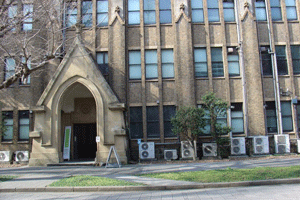
<div id="attachment_2521" class="wp-caption alignright" style="width: 310px"><a href="http://theags.org/wp-content/uploads/Hongo_airconditioningunits.gif"><img class="size-full wp-image-2521 " style="margin: 1px;" title="Hongo_airconditioningunits" src="http://theags.org/wp-content/uploads/Hongo_airconditioningunits.gif" alt="" width="300" height="200" /></a><p class="wp-caption-text">Air conditioning units on the historic buildings of the University of Tokyo Hongo campus</p></div>
<p>Speakers and participants at the workshop agreed about the enormous potential that campus projects have to connect teaching and infrastructure management in universities. Sustainability is not just the task of individuals, but needs to be the responsibility of communities, including university communities. For example, the ETH Science City campus looks for pathways towards sustainability that find a balance between different demands, between new buildings and renovation of the existing infrastructure, between workspace and nature, between infrastructure for teaching and meeting places for the exchange of ideas.</p>
<p>We emphasised that the motivation for change comes from this community potential. Tools for integrating the community into the campus development process are essential – good examples are competitions in which all the inhabitants of a campus can participate, or student projects to develop new ideas. Parallel to these formal channels, all participants should be able to bring their ideas directly to a central coordinator, so that the idea can be picked up and developed quickly. This could for example be done by a project or development office.</p>
<p>The discussion groups at the workshop all agreed that wide and intensive networking stimulates progress, particularly because sustainable urban planning is still at an early stage in many cities, and the sustainable campus community can make a significant contribution to this development. Science City is a beacon of sustainability in Zurich and a bridge between science, economy and the population. Sustainability stands for more than just energy efficiency and Science City realizes that integrated approach (see <a href="http://www.sciencecity.ethz.ch" target="_blank">www.sciencecity.ethz.ch</a>).</p>
<p><a style="display:none;" id="ddetlink1828142418" href="javascript:expand(document.getElementById('ddet1828142418'))">Click to open original text in German</a>
<div class="ddet_div" id="ddet1828142418"><script language="JavaScript" type="text/javascript">expand(document.getElementById('ddet1828142418'));expand(document.getElementById('ddetlink1828142418'))</script></p>
<p>Aufgrund der Bedeutung von Nachhaltigkeit in der Campusentwicklung, realisierte die Konferenz für erneuerbare Energie 2010 in Yokohama eigens dazu ein Workshop. An diesem Workshop waren sich sowohl Speaker wie auch Publikum einig, dass gerade bei Campusprojekten ein enormes Potential in der Verbindung von Lehre und Facility Management liegt. Verschiedene Speaker unterstrichen, dass Nachhaltigkeit nicht die Aufgabe von einzelnen ist. Vielmehr liegt die Nachhaltigkeit in der Verantwortung der Communities.</p>
<p>Wir versuchten zu betonen, dass die Motivation, etwas zu verändern, gerade aus diesem Potential der communities resultiert. Zentrales Werkzeug dabei ist die Integration dieser Communities in die Entwicklung. Dazu bieten sich beispielsweise Wettbewerbe an, bei welchen sich sämtliche Bewohner eines Campus sich einbringen können. Aber auch studentische Arbeiten können neue Ideen vorantreiben. Doch neben diesen offiziellen Kanälen ist es genauso hilfreich wie auch notwendig, den verschiedenen Beteiligten Möglichkeiten zu bieten, ihre Idee direkt bei einer Stelle zu platzieren. Die Idee kann damit rasch formuliert und angegangen werden. Dazu eignet sich eine Projekt- oder Entwicklungsabteilung, welche sich dieser Anregungen annimmt.</p>
<p>Die Gruppe des Workshops für nachhaltige Campusentwicklung war sich einig, dass ein breites und vertieftes Netzwerk hier weitere Fortschritte bringen kann, gerade weil sich mancherorts die Thematik Standortentwicklung noch in der Entwicklung befindet. </div></p>
]]></content>
		<link rel="replies" type="text/html" href="http://theags.org/research/sustainable-campus-workshop-at-the-renewable-energy-conference#comments" thr:count="0"/>
		<link rel="replies" type="application/atom+xml" href="http://theags.org/research/sustainable-campus-workshop-at-the-renewable-energy-conference/feed/atom" thr:count="0"/>
		<thr:total>0</thr:total>
	</entry>
		<entry>
		<author>
			<name>alexandra</name>
						<uri>http://</uri>
					</author>
		<title type="html"><![CDATA[Annual Report 2009]]></title>
		<link rel="alternate" type="text/html" href="http://theags.org/ags-international/annual-report-2009" />
		<id>http://theags.org/?p=2503</id>
		<updated>2010-07-09T14:27:03Z</updated>
		<published>2010-07-09T14:26:14Z</published>
		<category scheme="http://theags.org" term="ags international" /><category scheme="http://theags.org" term="annual report" /><category scheme="http://theags.org" term="outreach" /><category scheme="http://theags.org" term="publication" />		<summary type="html"><![CDATA[Annual Report 2009 is available.
Download pdf: AGS Annual Report 2009
]]></summary>
		<content type="html" xml:base="http://theags.org/ags-international/annual-report-2009"><![CDATA[<p>Annual Report 2009 is available.<br />
<a href="http://theags.org/wp-content/uploads/ar_2009.pdf">Download pdf: AGS Annual Report 2009</a></p>
]]></content>
		<link rel="replies" type="text/html" href="http://theags.org/ags-international/annual-report-2009#comments" thr:count="0"/>
		<link rel="replies" type="application/atom+xml" href="http://theags.org/ags-international/annual-report-2009/feed/atom" thr:count="0"/>
		<thr:total>0</thr:total>
	</entry>
		<entry>
		<author>
			<name>alexandra</name>
						<uri>http://</uri>
					</author>
		<title type="html"><![CDATA[AGS Newsletter 2010:2]]></title>
		<link rel="alternate" type="text/html" href="http://theags.org/outreach/newsletter/ags-newsletter-20102" />
		<id>http://theags.org/?p=2419</id>
		<updated>2010-07-09T13:47:41Z</updated>
		<published>2010-07-05T14:25:07Z</published>
		<category scheme="http://theags.org" term="newsletter" />		<summary type="html"><![CDATA[AGS newsletter 2010:2 is now available online.
The highlight in this newsletter is a report from AGS Annual Meeting 2010 held in Tokyo:  Global Change and Sustainability &#8211; pathways to the Sustainable Society in 2010.
Download AGS_Newsletter_2010:2 (pdf)
]]></summary>
		<content type="html" xml:base="http://theags.org/outreach/newsletter/ags-newsletter-20102"><![CDATA[<p>AGS newsletter 2010:2 is now available online.<br />
The highlight in this newsletter is a report from AGS Annual Meeting 2010 held in Tokyo:  Global Change and Sustainability &#8211; pathways to the Sustainable Society in 2010.<br />
Download <a href="http://theags.org/wp-content/uploads/AGS_Newsletter_2010_2.pdf">AGS_Newsletter_2010:2 (pdf)</a></p>
]]></content>
		<link rel="replies" type="text/html" href="http://theags.org/outreach/newsletter/ags-newsletter-20102#comments" thr:count="0"/>
		<link rel="replies" type="application/atom+xml" href="http://theags.org/outreach/newsletter/ags-newsletter-20102/feed/atom" thr:count="0"/>
		<thr:total>0</thr:total>
	</entry>
		<entry>
		<author>
			<name>alexandra</name>
						<uri>http://</uri>
					</author>
		<title type="html"><![CDATA[Sustainability under Rapid Demographic Change]]></title>
		<link rel="alternate" type="text/html" href="http://theags.org/ags-international/sustainability-under-rapid-demographic-change-ags-annual-meeting-2010" />
		<id>http://theags.org/?p=2367</id>
		<updated>2010-09-29T11:53:45Z</updated>
		<published>2010-06-22T14:41:38Z</published>
		<category scheme="http://theags.org" term="UT" /><category scheme="http://theags.org" term="ags international" /><category scheme="http://theags.org" term="extended life" /><category scheme="http://theags.org" term="research" /><category scheme="http://theags.org" term="AM2010" />		<summary type="html"><![CDATA[Workshop and plenary at the AGS Annual Meeting 2010
18 March 2010, The University of Tokyo, Japan
How can societies progress towards sustainability under rapid demographic change? This was a key issue at the AGS Annual Meeting 2010. The demographic structure of most developed countries is changing dramatically as a result of people living longer but having <a href="http://theags.org/ags-international/sustainability-under-rapid-demographic-change-ags-annual-meeting-2010">(more...)</a>]]></summary>
		<content type="html" xml:base="http://theags.org/ags-international/sustainability-under-rapid-demographic-change-ags-annual-meeting-2010"><![CDATA[<p><strong>Workshop and plenary at the AGS Annual Meeting 2010</strong><br />
<em>18 March 2010, The University of Tokyo, Japa</em>n</p>
<p>How can societies progress towards sustainability under rapid demographic change? This was a key issue at the AGS Annual Meeting 2010. The demographic structure of most developed countries is changing dramatically as a result of people living longer but having fewer children. At the same time, these societies must make drastic changes in the use of energy and natural resources to move towards environmental sustainability.<span id="more-2367"></span></p>
<div id="attachment_2399" class="wp-caption alignleft" style="width: 160px"><a href="http://theags.org/wp-content/uploads/AGSAM2010_Akiyama.gif"><img class="size-thumbnail wp-image-2399   " style="border: 0pt none; margin: 1px;" title="AGSAM2010_Akiyama" src="http://theags.org/wp-content/uploads/AGSAM2010_Akiyama-150x150.gif" alt="" width="150" height="150" /></a><p class="wp-caption-text">Prof. Hiroko Akiyama presented the work of the   Institute of Gerontology at The University of Tokyo</p></div>
<p>How do we design low carbon, sustainable cities for an ageing society? Will ageing societies have the capital to invest and the innovation necessary to achieve this with a declining population and a shrinking workforce? How can modern technologies be used to improve the quality of life of elderly people and allow them to continue as productive members of the workforce? How can pensions and health care be sustainably financed in an ageing society?</p>
<p>The talks and workshop at the AGS Annual Meeting 2010 have launched a discussion on how to relate the technological strengths of the AGS universities, and advances in research for sustainable urban futures, with gerontological and social research, to generate new insights and solutions.</p>
<p>Junichiro Okata of the UT Institute of Gerontology emphasised social sustainability at the centre of urban planning: there seems to be a consensus around a compact sustainable city model, characterized by high density but human-scale mixed-use streets and buildings (with homes designed to be flexible and affordable for different types of household), pedestrian-friendly streets and public spaces that encourage social interaction, and easy access to social services and infrastructure.</p>
<div id="attachment_2403" class="wp-caption alignright" style="width: 160px"><a href="http://theags.org/wp-content/uploads/AGSAM2010_Shirahase.gif"><img class="size-thumbnail wp-image-2403 " style="border: 0pt none; margin: 1px;" title="AGSAM2010_Shirahase" src="http://theags.org/wp-content/uploads/AGSAM2010_Shirahase-150x150.gif" alt="Prof. Sawako Shirahase of The University of Tokyo" width="150" height="150" /></a><p class="wp-caption-text">Prof.  Sawako Shirahase of The University of Tokyo gave the keynote &quot;Looking  for a Sustainable Society: family change in a rapidly ageing population&quot;</p></div>
<p>Ageing in place refers to a community environment where people can live with dignity throughout life. In Sweden today 95% of people over the age of 65 live at home, and in Japan in 2050 more than 40% of single households will be people over the age of 65. Inga Malmqvist from Chalmers explained how these communities need new designs for housing, mobility, services to the home, social participation, assistive information and robot technology, and health care services. For example, flats can be designed so that they can easily be reused in different ways, or converted from one four-room flat for a couple into two room flats for single residents.</p>
<p>New technologies could be very beneficial for meeting the needs of an ageing society. For example, robots could expand personal mobility in the neighbourhood and within the home, and provide assistance with household tasks, explained by Isao Shimoyama of the UT Information and Robot Technology Initiative and Masashi Koga of Hitachi Ltd. It is important that research investigates what motivates senior citizens of different ages to use new technologies, or what barriers prevent them from benefitting. Juliana Sutanto of ETH illustrated how aging is a creative process of continuous adaptation to declining physiological conditions, in which tasks are accomplished successfully in adapted ways, taking cues from the surroundings.</p>
<p>More information <a href="http://dir.u-tokyo.ac.jp/ags/am2010/" target="_blank">AM2010 website</a></p>
]]></content>
		<link rel="replies" type="text/html" href="http://theags.org/ags-international/sustainability-under-rapid-demographic-change-ags-annual-meeting-2010#comments" thr:count="0"/>
		<link rel="replies" type="application/atom+xml" href="http://theags.org/ags-international/sustainability-under-rapid-demographic-change-ags-annual-meeting-2010/feed/atom" thr:count="0"/>
		<thr:total>0</thr:total>
	</entry>
		<entry>
		<author>
			<name>alexandra</name>
						<uri>http://</uri>
					</author>
		<title type="html"><![CDATA[MIT Sustainability Summit]]></title>
		<link rel="alternate" type="text/html" href="http://theags.org/education/mit-sustainability-summit" />
		<id>http://theags.org/?p=2364</id>
		<updated>2010-07-09T12:50:58Z</updated>
		<published>2010-06-22T14:39:38Z</published>
		<category scheme="http://theags.org" term="MIT" /><category scheme="http://theags.org" term="education" /><category scheme="http://theags.org" term="student news" /><category scheme="http://theags.org" term="student" /><category scheme="http://theags.org" term="sustainability summit" />		<summary type="html"><![CDATA[23 April 2010, Cambridge, USA
Sustainability@MIT – MIT’s student group for sustainability – held their 2nd annual MIT Sustainability Summit on 23 April at Microsoft’s New England Research and Development Center.  There were over 200 students and sustainability professionals in attendance. The event was entirely student run and organized and supported through sponsorship contributions from <a href="http://theags.org/education/mit-sustainability-summit">(more...)</a>]]></summary>
		<content type="html" xml:base="http://theags.org/education/mit-sustainability-summit"><![CDATA[<p><em>23 April 2010, Cambridge, USA</em></p>
<p>Sustainability@MIT – MIT’s student group for sustainability – held their 2nd annual MIT Sustainability Summit on 23 April at Microsoft’s New England Research and Development Center.  There were over 200 students and sustainability professionals in attendance. The event was entirely student run and organized and supported through sponsorship contributions from The Alliance for Global Sustainability.<span id="more-2364"></span></p>
<div class="wp-caption alignright" style="width: 212px"><img style="border: 1px solid black; margin-top: 1px; margin-bottom: 1px;" title="2010 Sustainability Summit" src="http://dheera.net/photos/events/2010mitss/img_3794.jpg" alt="" width="202" height="151" /><p class="wp-caption-text">2010 Sustainability Summit</p></div>
<p>Keynotes were given by Peter Senge &#8211; a senior lecturer at MIT and founder of the Society for Organizational Learning; Kook-Hyun Moon -President of the New Paradigm Institute and former CEO of Yuhan-Kimberly; and Anne Kelly &#8211; Director of Governance Programs at Ceres.  Then attendees selected from 15 different interactive panels and exercises structured around the Summit’s theme of Collaboration and Communication. These included an introduction to systems thinking, a mock climate change negotiation, and a panel discussion on ESG investing. This year’s Summit left organizers and attendees energized for the 2011 MIT Sustainability Summit.  We hope to see you there!</p>
<p>Pictures and proceedings can be found at: <a href="http://sustainabilitysummit.mit.edu" target="_blank">http://sustainabilitysummit.mit.edu</a></p>
]]></content>
		<link rel="replies" type="text/html" href="http://theags.org/education/mit-sustainability-summit#comments" thr:count="0"/>
		<link rel="replies" type="application/atom+xml" href="http://theags.org/education/mit-sustainability-summit/feed/atom" thr:count="0"/>
		<thr:total>0</thr:total>
	</entry>
	</feed>